Sunday, June 14, 2015

Day 96 - Sustainability issues for 'keeping our female coders"

Yesterday I wrote about balance.  The fact that finding balance is particularly challenging in the tech industry has been agreed upon for some time, might have something to do with this (not so surprising) demographic analysis  graphic I found in the latest issue of Bloomberg Businessweek issue "What is Code?)

.... demographics from Stack Overflow's 2015 developer survey


Section 2.6 of Paul's Ford's 38,000 word essay shares insights on these demographic mostly related to the discouraging norms in the tech culture (including but not limited to sexual harassment so rampant that today's conferences are including codes of conduct to curtail it).


"The problem is pervasive: There are a lot of conferences, and there have been many reports of harassing behavior. The language Ruby, the preferred language for startup bros, developed the worst reputation. At a Ruby conference in 2009, someone gave a talk subtitled “Perform Like a Pr0n Star,” with sexy slides. That was dispiriting. There have been criminal incidents, too.
Conferences began to develop codes of conduct, rules and algorithms for people (men, really) to follow.
 From our own Local Conference in Burlington Vermont: 
If you are subject to or witness unacceptable behavior, or have any other concerns, please notify a community organizer as soon as possible … 

—Burlington Ruby Conference


"The problem with women in technology isn't the women" concludes Paul Ford in his 38,000 word essay written for  the latest issue of Bloomberg Businessweek (which  devoted  the whole issue to  What is Code?)

Saturday, June 13, 2015

Day 95: Revising my blogging goal

I set off to post something every day in 2015 that might interest girls in tech or others who are interested in the topics of women in tech.  You might have noticed a gap back in March  and another gap starting late April and early May.

What do those have in common!

 "A parallel increase in the need for 'attention to family'  and 'attention to a big work-related project!"


In March, I found myself trying to juggle a trip to Vermont that centered around some big work related projects and seeing my grandchildren and family.  Turns out "I can't do it all" and my blogging goal was moved to the back burner.

In late April/early May our mobile lifestyle brings us back to Vermont - which  brought both reuniting with my family and  increased professional commitments hurdling at me full force.  The enjoyment of both of these important forces in my life brought back the reoccurring theme  of "I can't do it all"  and again my blogging goal moved to the back burner.

Every time I experience or notice something that definitely should become part of this blog I feel the guilt from putting the TechSavvy Girls blogging goal on a hiatus rise.  But what it comes down to is a struggle I've had all my adult life ~ how to find the right balance between loved ones, profession, and personal goals.  It's a struggle many women feel from Sheryl Sandberg  to Anne Marie Slaughter.
In her recent article  "Why Women Still Can't Have it All"  offers insights on the balance struggles and even offers some recommendations of what must change for us to come close to finding that desired balance.

So in the perpetual search for balance I've decided to rewrite my blogging goal and instead of trying to write 'each day' in the TechSavvy Girls blog,  I'm going to change it to:

write at least 100 post this year that might be of interest to TechSavvy Girls readers... and when I reach the 100th post.. I'll just keep on writing - and stop counting.


Tuesday, April 28, 2015

Day 94 - Counting success of unlocked doors

As I continued to think about the She++ video that I watched yesterday, I was reminded that one of the challenges of encouraging more women to develop their aptitude and confidence with technology is that we don't always celebrate our count all our successes. 

The women in the She++ panel echoed some of the same messages I would tell my high school students. 

Continue to develop this MOST important skills of LOGIC and ALGORITHMIC

THINKING… that mindset can be applied to a variety of different thinking

A little bit of programming knowledge can unlock all these doors

You can go into any industry,  science,  fashion,  math

Finding problems that are worth solving and then solving them using computing

And when you successfully communicate that message to our women and girls and they start to feel empowered with technology, they may choose to very different field than "Computer Science"  to apply their new technology skills.

I had many girls pursue college and career choices they would have never considered had they not become more tech savvy from accounting to biology to civil engineering.

These successes must be celebrated, but are not easy to count.

It is easier to measure the number of  women in computer science.

But let's not measure our success only by the increase or decrease in computer science fields.  Many of our tech-savvy girls are walking through doors that were unlocked because of the work we have done raising their awareness, skill level, and confidence with technology.


Monday, April 27, 2015

Day 93 She++ tackles gender stereotypes in computer science


I just  finished watching a mini-documentary created by the team at She++
and immediately started to peruse their website  http://www.sheplusplus.org/  discovering an amazing team of talented young women committed to creating a culture in computer science that is more appealing to women.


They have done a great job combining some engaging animations and snippets of interviews to create a 12 minute message aimed at changing some of the stereotypes that exist about computer science careers.

One thing that really struck me was the diversity amongst the women who have bonded together in carrying our the mission outlined on the she++  ABOUT page.

OUR MISSION
she++ seeks to dismantle the untrue stereotype that computer science is not a career for women. We work with the technology industry to create a culture that is more appealing to women, and we work with women to dismantle harmful perceptions that they cannot succeed in the technology industry.

A quick look at the names and faces of the women on their team speaks to the fact that it is possible to gather a room full of people interested in computer science that are not 'white' 'males'.   What started as a conference of 250 attendees at Stanford has grown to a whole community looking to change the face of computer scientist.  

In this twelve minute  documentary,  you will learn more about the variety of interest  and skills that make up a panel of women from Facebook, Pinterest, Google, Microsoft, Box and other tech related companies.  The panel aims at  showing us that a computer science is not an "antisocial white male living in a cubicle".   I'm not so sure that this is still the stereotype that prevails when we think of careers in computer science, and I wonder if using the 'stereotype' to combat the 'stereotype'  is helpful,  but there certainly are other barriers for women, that the panel does address.

Their description of what it was like for women enrolled in their  first computer class was spot on.  I have  certainly felt many of the emotions that were described in the documentary and have watched young women that I have steered into computer science courses experience the same.

"I spent a lot of time thinking that I was not qualified for this.. I had not been coding since I was 12" 
"I thought I was failing that class all the way through" 
"There was an expectations  was that if you are studying computer science you must have used this before, I had hardly touched a computer."

The women warned that part of this may have been due to the fact that the "Intro to CS class was a weeder class and a bit more difficult."

Obviously the women in the class were not the only ones who find Intro to Computer Science classes challenging.  However,  according to research conducted at Stanford,  this plays out differently for women than it does for their male counterparts.
"When women don’t succeed at first, they blame themselves, and when a man does not succeed he blames the course and the test, when a women gets a B+ she blames herself.. when a man takes a B+ he thinks he is doing fine."
This drives home the fact that not only must we create more opportunities to bridge the experience gap that exist between girls and boys with computers and engineering type tasks,  but we must also include an increased awareness of that experience gap and an acceptance that "just because something is hard, does not mean its not fun  or that you are not good at it".    

This is sometime I try to do with each of the TechSavvy Girls events that I design.

I still remember one of my former students, Samantha, coming back from her first year of college saying to me
"Ms. deLaBruere,  if you had not helped me understand the experience gap, I would have dropped out of my  Intro to Civil Engineering class.  The boys were already half way through the assignment by the time I had set up the tools I needed to start the project. Not being familiar with the tools, meant I had to find the tool and orient myself to it before I even started."   

I have heard people complain that some of the information we put out perpetuates the image that girls as victims,  but I disagree.  If framed correctly, it can help girls prepare for that "Weeder" class experience  and understand that having less experience does not mean you don't belong.   Congrats to t the team from Stanford, for helping raise awareness. 


Sunday, April 26, 2015

Day 92 Ohms, Voltage, and Amps in Maker projects


Yesterday I started to share that my mental model around volts, amps, and ohms was finally emerging to a point where I felt that the fog had lifted. While that post was a reflection of the learning process by which this happened, today I thought I’d do a quick explanation of that mental model using the explanation provided in this Sparkfun tutorial and apply it to some of the project we have been making in our Girls Make IT sessions and see if it might resonate for some of you.  

By the end of this post, it is my hope that you might have a better understanding of why the words (volts, amps, and ohms)  might impact  your project design.  It will not be the goal of this post that you be able to calculate the ideal solution by which to power your project,  but you will be tuned in to how these materials might impact the design solution.  It is my goal that as you notice these words in the future you will be less likely to ignore them and start to create your own data points of how materials rated with different values (volts, amps, ohms) might impact your project design. 


First of all a mental model is built around our experiences and current understanding of the world. Water is s something most of us have experience with. Most of us have experience with garden hoses, water faucets, water towers, and with the experience of letting the current in a river carry us downstream. These experiences can help us better understand amps, voltage, and ohms.

AMPS

The amount of energy that an electrical current is often measured in something we call AMPS (or ampere). To put it in perspective, an oven might use 10 - 20 amps while a clock radio would need only 1 amp. Amps is the total amount of current that is available or needed to power an object. 


Water example from Sparkfun


Let’s say you have a 55 gallon water tank in your home for hot water. The design of the water tank including how much water it can hold will determine the flow of the water to your sink or shower.  The design of your battery will determine the flow of the current from the battery to your project. The flow of the current in electricity is measured in a unit called AMPS.  

 The number of AMPS a battery has (if fully charged) is only one part of the equation of whether it is a good solution to power your project. 


VOLTS


Let’s say you connect your water tank to a hose laying flat on the ground. Chances are the water would trickle through the hose and be available to you, but there would be very little pressure behind it. On the other hand, if you raise the water tank up and place it up higher than the hose, the water pressure will increase and the water will come out the other end of the hose with enough pressure to be useful. You’ll definitely want more pressure to power wash your house than you will need to rinse off your dishes or take a shower. 

When working with electricity, the design of the battery can also provide more pressure behind the current making it useful for different types of tasks. The force by which the current is being pushed out towards us is measured in volts. The more volts, the more pressure or force is behind the current as it moves through your circuit. To put it in perspective, check out the difference between the clock radio and oven in our diagram above; an oven needs a power source that sends electrical current at 220 volts, while the clock radio only needs 12 volts to work.

Although we might have a lot of ‘water’ available, we are familiar that water can have a much different impact if it is flowing slowly or trickling through a hose laying flat than it can if you left one end of the hose higher. Consider the impact that a water coming through a hose has in the picture of the power wash hose above versus the impact that the water being being poured in this glass has. The water coming through the hose would knock the glass right out of your hand. Just as water pressure can increase the impact of the water has when it comes in contact with an object, so can electrical current. When it comes to electricity, we use a measure called voltage to measure the pressure of an electrical current. 

We need a measure of for this type of pressure when it comes to electricity The same is true for electrical current. Just because we have enough ‘electricity’ does not mean it is coming through the wire with enough pressure to power the project. An oven needs a power source that sends electrical current at 220 volts, while the clock radio only needs 12 volts to work.


RESISTANCE / OHMS


Finally sometimes we have a power source with a lot of water and a lot of pressure, but the amount of current and speed of the current coming at us at once can be slowed down by adding some resistance to the hose or pipe through which the water is traveling. Have you ever bent a garden hose to slow down the flow of the water, while you grab the hose to aims it. When you did this you were adding resistance. Another way to add resistance would be to change the size of the hose. A narrower hose offers more resistance as water does not flow through it as easily as it does the wider hose.   Perhaps your shower has a shower head that allows you to adjust the pressure.


Your shower head can add more resistance thus slowing down the flow or increase the pressure by reducing the resistance.   The same is true for electricity.


In your maker project you select various materials for electricity to pass through based on the resistance it has. Some materials offer little or no resistance, while others materials have a lot of resistance.   Most metal or wire has very little resistance and connecting them to your battery allows the current to pass through at full force. If you have a 3 volt battery, your current passes through at 3 volts, while if you have a 12 volt battery the current has 4 times the pressure behind it. The amount of resistance is measured in Ohms or Ohms per meter.


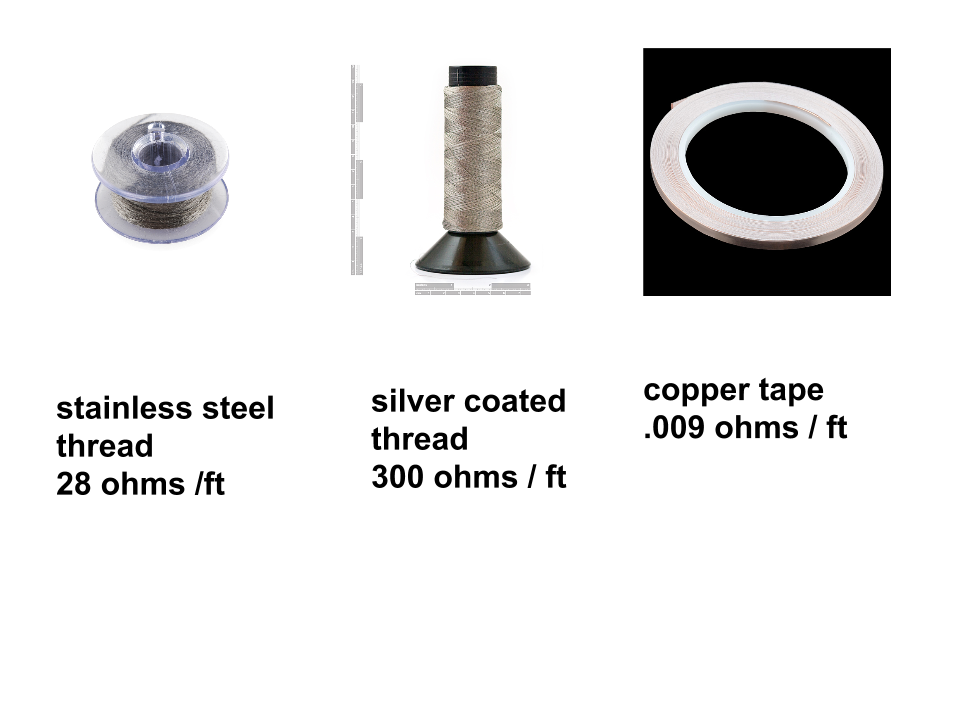
Some materials like conductive threads are created with material that have more resistance and thus conductive thread allows the current to flow through with much less force/pressure than a piece of copper tape or a wire.  One of the benefits of this is that you can use conductive thread with power sources without frying your LED's because of too much voltage. 


For example silver coated conductive thread may have 300 ohms of resistance per foot while stainless steel conductive thread may have 28 ohms of resistance per foot. When you compare that to the .009 ohms of resistance you might find in a foot of copper tape, you can see that the materials you use to design your project make a huge difference in the way the project works (or doesn’t work).

In some future blog post, we'll put this knowledge to use with some practical examples of maker projects.  We'll even learn to use ohms law to calculate the amount of current needed for our maker projects. 

But hopefully your vocabulary will include the words, amps, voltage, resistance, and ohms and you will start to pay attention to the number of volts and amps as well as the resistance from using various power sources and materials as you design your  projects.  


Saturday, April 25, 2015

Day 91 - The Journey to Understanding Ohms, Voltage, and Amps

Before I started MAKING with electronics I never gave batteries much thought, except for  Christmas day when we would often be frantically looking for batteries for the presents where "batteries were not included."    But lately I've had lots more reasons to think about power sources as I create and make.  As I started to wonder about how to provide power to my projects, I started to wonder about volts and amps and wanted to get a better understanding of "why"  certain power solutions would work better than others.

As an educator I'm acutely aware of the role that motivation and frame of reference play on creating the optimal learning environment.  My maker projects provided the motivation.  However I still lacked some of the frame of reference needed to understand the explanations I was reading about ohms law.  But with each project I made,  I started to gain  experience that allowed me to build more data points slowly creating a frame of reference.    Watching the sparks fly when two dangling pieces of conductive threads became entangled made me wonder:

  "What was different about my power source this time that caused such a reaction?"
   "Why had there been no sparks flying on previous projects where threads had accidentally touched?"  
      "Might some of my projects create fire hazards?"

As the data points and list of questions grew, so did my ability to predict what might happens when I combined circuits, batteries, and conductive materials.  And with each iterations of predicting, designing, and testing solutions for my projects,   my frame of reference started to grow, my experience gap started to narrow.   I felt ready to tackle readings that would deepen my  understanding of the science behind the flow of electricity so that the information about volts and amps on the materials I was using to make would finally be useful in designing solutions to my projects.

But even though the vocabulary was more familiar as I read through various explanations of volts, amps, and ohms law,  I struggled with creating a mental model that felt complete.   Yet, despite the fact that  there were still some foggy parts for me,  it seemed that some of what I was reading as I was making was finally accessible and the fog was lifting.   I was no longer dismissing the information I read as gobbly geek;  I had deeper motivation for bridging the knowledge gaps  and had new experiences to connect pieces of the explanations to.   Maker  empowerment was setting in and added a degree of  confidence that I could grasp these new concepts as in produced in me an inclination to want to understand the interconnections of the systems that made up my world.  I also had  an important additional ingredient--the patience of a partner who was willing to listen as I described new renditions of my mental model and gently point out misconceptions with yet another explanation of the parts that were still foggy.  Meanwhile I kept playing/making and reading.   And finally,  more than a year into my playing with circuits, I feel like the fog has lifted about around my  understanding about volts, amps, circuits, and ohms law.    Last night I reread the Sparkfun explanation of voltage and amps and the water metaphor finally worked to complete the mental model that had been slowly building over the past year.


As an educator who is fascinated by the process of learning,  I'm intrigued by the variables that interconnected in my learning journey.  I know that no two learners will go through the same journey,  but I feel my reflecting and understanding my journey will help me better understand the various places in the journey that those 'making' around me might be at.  It will also help me design experiences that might help others on their journey of understanding the interconnected systems of the world around them, especially those who might have had similar experience gaps.

There have been plenty of times when I've said to myself  "who are you kidding - you don't belong here in this world where most of those around me seem to have a stronger background and understanding of science." Girls Make It Series of workshops has been shaped by that experience and the reactions from both participants and observers has validated  my feeling the designs for my workshop do connect with learners like me -  and that I my value might be in bringing diversity to the maker culture, but to also bring deeper understanding of technology, science, and making to a diverse set of learners.  But today, I feel that the lack of such a background has provided me with a different type of insights and that maybe that insight can be valuable in the maker culture.  Much of the design of my

Growing up in a household of 5 girls in the 60's meant that there were not a lot of toys that helped me experience electronics and mechanics.   I don't remember much about science class in our 4 room school house in rural Vermont.  Our elementary teachers were generalist and I imagine that my lack of vivid memories about science class is indicative of the quantity and quality of science education we experienced.

I have some faded memories of earth science and biology in high school, but nothing that excited me to learn more.  I do have a vivid memory of my guidance counselor telling me that I would never get into college after I insisted in signing up for  sewing class  over chemistry class (scheduled at the same time).  That year I learned that I wasn't very good at sewing, and signed up for chemistry my senior year -- which of course meant I never got the opportunity to experience physics.    Somehow I decided that science was not for me and managed to make it through four years of college avoiding any science classes by filling my distribution requirements with math classes.


What is gender?  Was it environment?  Was it environment due to gender and culture that contributed to my experience gaps in all things science.   Whatever it was,  I NOW get to experience bridging the gap and totally fascinated by that process.  How can my introspection about my process contribute to designing experiences that will impact those who don't 'naturally'  engage with creating and making? How can creating those experiences contribute to helping non-traditional 'makers'  deepens their understanding of the interconnected systems that make up their world?

There could have been no better time in my career for me to have discovered the series of book in the Interconnections:  Understanding Systems through Digital Design".  And to think I almost walked right by the National Writing Project table at the SxSw Edu Conference this year.   Framed in a pedagogical beliefs that align with Common Core and Next Generation Science Standards,  these books offer educators a field guide to integrating making into their curriculums.  The authors have designed a resource  for both in school and out of school educators that can guide them as they build their own confidence and skills to introduce making into their curriculum.




Friday, April 24, 2015

Day 90 - Learning about EL Wire

Every time I see EL Wire on a project, I'm mesmerized by the glow.  So I naturally assumed it was complicated.  Turns out its one of the simplest ways to electrify a piece of textile.

EL wire stands for electroluminescent wire. This wire can easily be attached to clothing or other materials that bend or have moving parts.  And it comes in fun colors and shapes. 

To add that that EL  glow to your projects, you basically need 3 things

1)  a long strip of EL wire


2) an EL Inverter Battery Pack


3) an some batteries


Or consider getting a starter kit with both the wire and the battery pack.

The first think you need to  know is that YOU CANNOT USE just a standard battery like you do with most LED eTextile project.   You MUST get an INVERTER battery pack.   This makes the power source for your eTextile project a little harder to conceal (and in the case of my hat a little clunkier)

Sparkfun has an inexpensive inverter and lots of fun colors available in its selection of EL wire .


In my project, I ended up creating a design that used the whole length of the green wire I happen to have handy.   However, you can cut it any size you want, as long as you reseal the end with hot glue or other similar substance.

But it must be powered by AC (alternating current) -- the same type of power that comes out of the electrical outlets in your house.  But since it would not be practical to have your e-Textile projects plugged into an outlet,  you can get portable power but using an inverter battery pack.  The inverter changes the direct current power that batteries produce and 'inverts' or changes it to AC power needed by your EL wire.

Your EL inverter/battery pack will include a JST connector that connects with the JST connector on your EL wire.   Most EL inverter/battery packs contain a button that changes the look of the EL wire from 'ON'  glowing, to  'Chasing"  or "Blinking", to OFF, every time you press the button.


 Here is a short video demonstration from SparkFun.


The geek in me wanted to do more with this cool looking wire.  With a little more research I read that Sparkfun carries two boards that can help me gain some control over the EL Wire ( the EL Sequencer and the EL Escudo Dos).

I also found a few EL Wire hacks that allow you to control the ON OFF of the inverter without having to manually press the button.  I started to think about how I could use this Hack (which uses an Arduino to control a Relay that controls the power to the inverter) in some of my projects.  This made me feel that the despite its simple on/off switch power option,  that I could control how and when my EL Wire turns on with an Arduino, if I learned to use a relay.


 Guess what's next on my list of Arduino skills to learn!  Stay tuned!